Paws With a Purpose: Stephens Students Train Service Dogs That Change Lives
A CAMPUS PARTNERSHIP WITH NATIONAL IMPACT
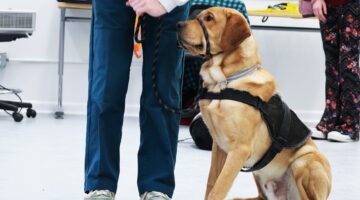
On any given day at Stephens College, it’s not unusual to see dogs walking across campus with students – settling into classrooms, navigating busy hallways and learning how to stay focused in real-world environments. For some of these dogs, campus life is more than companionship. They are future service animals, training to support veterans with disabilities and children with autism through a hands-on partnership between Stephens College and Retrieving Freedom, Inc. (RFI). Most students involved in the program are enrolled in Stephens’ Animal Behavior program and work directly with service dogs during a critical stage of their development. The experience provides professional-level training while advancing a mission that reaches far beyond campus.
RFI is a nonprofit organization that partners with colleges and correctional facilities nationwide, bringing together students, inmate handlers and professional trainers to prepare dogs for lives of service. Stephens is one of several colleges contributing to this national effort.
LEARNING BY DOING
RFI’s Program Manager Bailey Inman leads the training at Stephens College, meeting weekly with students to check each dog’s progress, conduct group training, monitor health and provide guidance on weekly training goals.
“This is our second-year, third semester with Stephens,” Inman said. “The students are working with stage-two dogs in training.”
The dogs come from foster programs as puppies and are taught beginner tasks throughout the semester until they reach about one year old. Students focus on foundational skills that will later be refined and completed by professional trainers. Many students return each semester, working with multiple dogs and gaining experience that mirrors professional service dog training environments.
TRAINING DOGS FOR VETERANS AND CHILDREN
Dogs trained through RFI go on to assist veterans with mobility needs or PTSD and children with autism, performing tasks that promote independence, emotional regulation and safety.
“We work on deep pressure tasks to help with anxiety, as well as mobility tasks for veterans,” Inman said. “A big focus is also obedience and public access – making sure the dogs are prepared for real-life environments.”
RFI has been operating for more than a decade, placing over 100 service dogs with individuals in need, while impacting more than 100 students nationwide through partnerships like the one at Stephens.
RESPONSIBILITY, TEAMWORK AND REWARD
Sophomore Apryl Bennett has served as a primary handler every semester that Stephens has participated in the program. This semester, she is working with her third dog, Chewy. Primary handlers are responsible for their dogs around the clock – in class, at home and everywhere in between.
The program also includes secondary handlers, who step in when primary handlers are unavailable.“The system works because it teaches students teamwork and responsibility while making sure the dog’s routine stays consistent, which is critical for their training,” Inman said.
Bennett added, “It makes sure the dogs never have to sit in their crate all day.”
AN IDEAL TRAINING ENVIRONMENT
LEARNING ON AN ANIMAL-FRIENDLY CAMPUS
Stephens’ animal-friendly campus provides a perfect environment for socializing the dogs and helping them adapt to busy, real-world settings.
“It’s pretty easy to socialize them here,” said Bennett. “I’m around a lot of other dog handlers and dog lovers, so they’re constantly learning how to interact.”
“One of the biggest benefits of a college campus is the amount of natural socialization the dogs get,” Inman said. “They’re learning how to walk through crowded space, settle in classrooms, and stay focused around distractions – all skills they’ll need once they’re placed with a client.”
PREPARING STUDENTS FOR MEANINGFUL CAREERS
Beyond hands-on training, the program exposes students to a wide range of career paths in animal behavior, service dog training and animal welfare.
“This experience helps students see what professional dog training actually looks like,” said Inman. “A lot of Stephens students come from equine backgrounds, so this gives them a chance to apply similar training principles in a new setting.”
“They’re not just learning techniques,” added Inman. “They’re learning how their skills can change someone’s daily life.”
After the semester, the dogs move into RFI’s correctional facility training programs, where inmate handlers continue their development before professional trainers prepare the dogs for placement – usually around two years old.
MAKING AN IMPACT BEYOND CAMPUS
For Bennett, the most rewarding part is knowing the dogs she trains will eventually support someone in need.
“Knowing I’m helping someone who can’t always help themselves – it’s a really good feeling,” Bennett said. “Whether it’s a veteran or a child with special needs, the dog just knows what to do.”
Still, saying goodbye to the dogs she’s trained is emotional.
“The first dog I had, Violet, was definitely hard,” said Bennett. “I held it together until I got back to my room and then just bawled my eyes out. The second time was easier because I understood the process and knew they were going to a good home.”
As one of the several colleges partnering with Retrieving Freedom, Inc., Stephens College plays a vital role in a larger mission – preparing service dogs while giving students transformative, hands-on learning experiences that extend far beyond the classroom.