A Summer of Discovery: Stephens College Wraps up Second Year of STEM Partnership with Mizzou
As the academic year begins, Stephens College is celebrating the successful conclusion of its second year partnering with the University of Missouri (MU) College of Veterinary Medicine (CVM). Through the Women in STEM Research (WiSR) program and its collaboration with Mizzou’s Veterinary Research Scholars Program (VRSP), Stephens’ students spent the summer doing more than studying science – they were leading it.
This fall, eight incoming students will join the WiSR program, building on the momentum of a partnership designed to prepare women for high-impact careers in clinical research, biotechnology and veterinary medicine. By combining Stephens’ personalized, supportive environment with the Tier 1 research resources of MU’s CVM, the program continues to offer a pathway that is as rigorous as it is unique.
The Living Laboratory: Research in the Stables
While many students come to Stephens for its renowned equestrian program, WiSR turns the stables into a ‘living laboratory’ for STEM students.
The program grew from a collaboration between Dr. Brandon Moore, Associate Teaching Professor at MU, and Dr. Aaron Ericsson, Associate Professor and Director of Graduate Studies at MU. At the time, Moore was serving as a faculty member in the Stephens Biology program, while Ericsson had been assembling a global database of horse microbiomes but lacked a controlled environment for experimental work. The 20 to 30 horses maintained at Stephens provided the perfect solution.
“The goal is to use these horses to do controlled experiments to test specific hypotheses about how different feeds, diets, behaviors, and management practices affect the microbiome,” said Dr. Michael Barger, Dean of the Women’s College. “We take largely observational data and provide an experimental basis for understanding the mechanisms involved.”
Ericson and Moore laid the foundation for the partnership before Moore handed the reins over to Barger. Moore eventually transitioned to a role in MU’s CVM program, continuing his work with WiSR and VRSP students and teaching about biases in science.
Since then, Dr. Barger said he now works closely with Dr. Ericsson and Dr. Tamara Hancock, MU CVM Assistant Teaching Professor, to continue growing and building both WiSR and VRSP.
Students gain hands-on experience from day one, and it continues throughout their Stephens’ career. Freshmen execute structured projects, while sophomores refine protocols. By their junior year, students design their own experiments, and seniors take on leadership roles – mentoring younger cohorts through the complexities of data collection and animal care.
A Summer of Intensive Research at Mizzou
While the research begins at Stephens, it expands significantly during the summer through the VRSP. The 10-week intensive internship at Mizzou CVM pairs Stephens’ “WiSR Scholars” with faculty mentors and graduate students in the Doctorate of Veterinary Medicine (DVM) program.
For many participants, this summer marked their first experience working within a large-scale research community.
“The partnership gives students direct access to graduate students as they complete their degrees,” said Barger. “Students at small schools often lack that peer-mentoring aspect because those schools lack graduate programs in the sciences. This is one way to ameliorate that structural deficit.”
The experience proved equally rewarding for mentors. “Faculty, grad students, and researchers gain mentoring experience—for some, this is their first time—and benefit from the curiosity of the student scholars’ eager minds,” said Hancock.
To support full-time commitment, the program has increased its financial support. Students can receive a $3,000 stipend for the summer or academic credit, ensuring these research opportunities are accessible regardless of financial background.
From the Data Blitz to the National Stage
A key pillar of the WiSR program is the “research lifecycle.” Science doesn’t end in the lab; it ends with communication. In October, students will have the opportunity to present their findings at the “Mizzou VRSP Data Blitz,” a fast-paced presentation event where they share their work with peers and faculty.
“Presenting their work facilitates confidence building and helps scholars take ownership of their project,” said Hancock. “We hope they consider it their own masterpiece.”
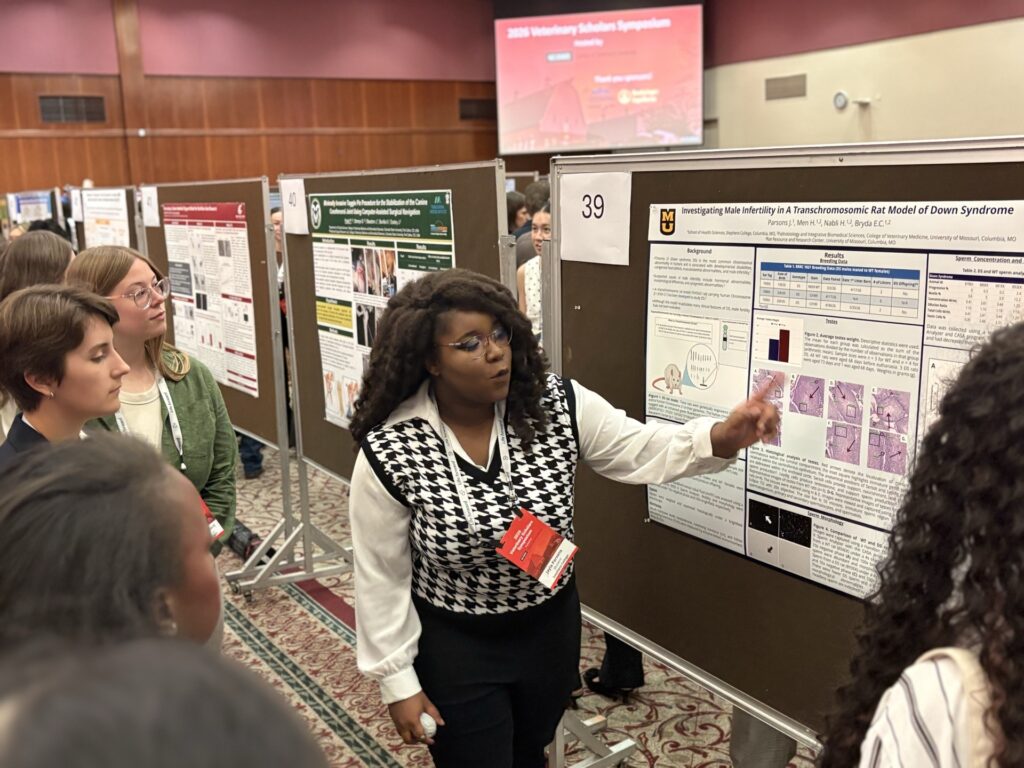
For some, the journey goes even further. At the beginning of August, Stephens sent Jayla Parsons to the National Veterinary Scholars Symposium at North Carolina State University. Seeing a project through from conception to national presentation—and potentially into a peer-reviewed publication—is an invaluable asset for students applying to highly competitive graduate programs or vet schools.
Building the Pipeline: Real-World Success
The ultimate goal of the WiSR-VRSP partnership is to build a pipeline of future researchers and veterinarians, particularly in the equine field, which currently faces a national shortage.
The vision is already becoming a reality. One recent success story involves a Stephens junior who participated in VRSP, returned as a scholar three more times, and is now a DVM graduate heading into a comparative medicine residency. Other participants have successfully transitioned into veterinary programs at Mizzou and Kansas State University.
“Research consistently shows that having positive mentoring relationships in science helps foster a stronger science identity and a sense of belonging,” says Dr. Craig Franklin, Director of VRSP.
A Community of Support
This ambitious program is made possible through a robust network of supporters. Funding comes from a variety of sources, including grants from Boehringer Ingelheim, the American Society for Laboratory Animal Medicine, and an endowment from IDEXX BioAnalytics. Additional support is provided by the Student American Veterinary Medical Association (SAVMA) and individual donors.
“None of this would be possible without the incredible support from our sponsors, the mentors, and the Colleges,” said Franklin.
The Stephens Advantage
By centering student development and leveraging the research expertise of a major university, Stephens College is proving that a small women’s college can offer world-class research training.
As Barger summarizes: “If we put good scientists out in the world, the science will take care of itself. Our job is to build good scientists.”
Through WiSR and VRSP, Stephens is doing exactly that—one horse, one microbiome, and one student at a time.